
Description
Buy Negative SEO Service – Professional Campaigns for Guaranteed Results
In today’s hyper-competitive digital landscape, securing a top search engine ranking is a constant, brutal battle. When your competitors unfairly dominate the first page, your own visibility suffers, consequently limiting your growth and revenue potential. If you’re looking to buy negative seo service that delivers strategic and impactful results, then understanding the underlying tactics is the first essential step to finally leveling the playing field and claiming your rightful market share.
This comprehensive guide explains every facet of negative search engine optimization in exhaustive detail. Furthermore, it will explore the exact techniques used to disrupt competitor rankings and demonstrate how a professional campaign can strategically reposition a brand for success. Ultimately, a well-executed negative SEO strategy turns complex SEO challenges into clear opportunities for market dominance. For a full scope of digital strategies, you can explore our complete list of services.
What is Negative SEO and How Does It Actually Work?
First and foremost, Negative SEO is a strategic set of techniques aimed at lowering a competitor’s website rankings in search engine results pages (SERPs). Instead of improving a site’s own SEO, a negative SEO campaign focuses on creating powerful signals that make a competitor’s website appear low-quality, untrustworthy, or manipulative to search engines like Google. In short, it is the practice of offensive search engine optimization.
The core principle is simple but incredibly powerful. Specifically, search engines use complex algorithms with hundreds of ranking factors to determine which pages are authoritative and valuable. These same algorithms also have strict guidelines to identify and penalize spammy or manipulative behavior. A negative seo attack works by exploiting these very guidelines in reverse. By pointing a massive volume of spam signals at a competitor’s domain, a campaign can trigger algorithmic penalties or filters that cause their rankings to drop significantly, sometimes even completely off the first few pages.
Therefore, you can think of it as using the search engine’s own rulebook against the competition. From building thousands of toxic backlinks to duplicating their content across the web, each tactic is designed to make the target site look bad in the eyes of Google’s crawlers. A well-executed campaign is a discreet and effective way to gain a significant competitive edge.
A Comprehensive Breakdown of All Negative SEO Tactics
To truly understand the power of a professional negative SEO campaign, it’s essential to know the entire arsenal of tools. Below, we break down every major tactic used by experts to de-rank competitors. Each strategy targets a different aspect of a website’s SEO profile, and a successful campaign often combines several of these for maximum, undeniable impact.
Backlink Attacks: The Foundation of a Negative SEO Campaign
A website’s backlink profile remains one of the most critical ranking factors. Consequently, it’s also one of the most vulnerable to attack. These methods focus on destroying the authority and trust of a competitor’s domain by flooding it with toxic link signals, effectively poisoning their digital reputation from the ground up.
Spammy Backlinks (Link Farm/PBN Spam)
What It Is: The most classic negative SEO tactic, this involves creating a massive number of low-quality backlinks pointing to a target website. These links typically originate from link farms (websites created solely to link out) or Private Blog Networks (PBNs).
How It Works: Search engine algorithms view high-quality links as votes of confidence. Conversely, they view a sudden influx of thousands of links from irrelevant, spam-filled, or non-indexed websites as a clear attempt at manipulation, which triggers a penalty.
Why It Is Effective: This method directly attacks a core ranking principle. It pollutes the target’s link profile to such an extent that search engines lose trust in the domain’s authority. The sheer volume makes it nearly impossible for the target to manually clean up, ensuring a long-lasting impact.
Example in Action: A competitor ranks #1 for a valuable commercial keyword. A negative SEO expert uses automated tools to build 200,000 backlinks to their ranking page over two weeks. These links come from foreign forum profiles and blog comments. Google’s algorithm detects this unnatural velocity and pattern, penalizing the site and causing it to drop in rankings.
Common Defense Mechanisms: The target’s primary defense is to regularly monitor their backlink profile using tools like Ahrefs or Semrush and then upload a disavow file to Google Search Console. However, this is a reactive process that is often too slow to prevent the initial ranking drop from a large-scale attack.
Anchor Text Spam (Over-optimized or Irrelevant Anchors)
What It Is: This attack involves building thousands of backlinks that use either the exact same keyword anchor text repeatedly or completely irrelevant, spammy anchor text.
How It Works: A natural backlink profile has diverse anchor text. When a profile shows that 90% of its links use the exact same commercial anchor text, it looks highly manipulative. This over-optimization is a clear signal for penalties. Alternatively, using toxic anchors creates a harmful association.
Why It Is Effective: This tactic exploits the part of Google’s algorithm designed specifically to combat link manipulation. It makes the target’s own SEO efforts look like black-hat spam, using the search engine’s own rules against them with devastating precision.
Example in Action: A competitor’s main keyword is “luxury car insurance.” An attacker creates 50,000 backlinks where the anchor text is exactly “luxury car insurance” for every single link. This unnatural ratio alerts the algorithm, which is designed to spot and penalize such manipulation, resulting in a swift ranking drop.
Common Defense Mechanisms: Similar to general spam links, the main defense is a disavow file. A savvy target might also try to dilute the over-optimized anchors by building their own high-quality links with branded or neutral anchor text, but this is an expensive and time-consuming counter-measure.
Links from Hacked or Compromised Sites
What It Is: An advanced tactic that involves placing links on legitimate websites that have been hacked. These are particularly damaging because they originate from otherwise authoritative domains.
How It Works: A negative SEO practitioner can purchase access to compromised websites to inject links pointing to a competitor’s site. When Google discovers a trusted site has been compromised, it may devalue the link and view the target site with suspicion for being associated with the hack.
Why It Is Effective: It creates a powerful “bad neighborhood” signal. Being linked to from a hacked site is a strong indicator of untrustworthiness. For the target, these links are difficult to get removed as they have no control over the hacked third-party site.
Example in Action: A popular industry news blog gets hacked. An attacker gains access and discreetly adds a link to a competitor’s site in the footer of every page. Once the hack is detected, Google may distrust the competitor’s domain for benefiting from the scheme.
Common Defense Mechanisms: The target’s only recourse is to disavow the domain of the hacked site and, if possible, attempt to contact the webmaster to inform them of the hack. This is often a slow and frustrating process with no guarantee of a response.
Directory/Forum Spam Entries
What It Is: This involves using automated software to create thousands of profiles on low-quality web directories, forums, and guestbooks, with each profile containing a link back to the competitor’s website.
How It Works: This is a volume-based attack. While one of these links is worthless, tens of thousands create a powerful spam signal. It makes the competitor’s link profile look like it was built by a cheap, amateur SEO from a decade ago. Search engines easily recognize this outdated and spammy technique and penalize the site accordingly.
Example in Action: A target competitor is a local law firm. An attacker might use a tool to automatically create 200,000 profiles on forums worldwide, all linking back to the law firm’s homepage. The sheer volume and complete irrelevance of these links would trigger a penalty.
Common Defense Mechanisms: Diligent backlink monitoring and disavowing are the only real defenses. Because these links often come from thousands of different domains, the disavow process can be particularly tedious for the target to manage.
Malicious Redirect Attacks (301/302 from Compromised Domains)
What It Is: This tactic involves buying expired or spammy domains and using a 301 (permanent) or 302 (temporary) redirect to point all of their toxic link history directly at a competitor’s website.
How It Works: When a domain is 301 redirected, it tells search engines that it has permanently moved and all of its ranking power (and penalties) should be passed to the new location. An attacker can acquire domains that have been penalized and redirect them to a competitor, effectively transferring the penalty.
Why It Is Effective: This is a highly effective way to directly pass on a Google penalty. The target site inherits the toxic history of the redirected domain, which can cause a rapid and severe drop in rankings that is very difficult to diagnose.
Example in Action: An attacker finds a domain that was previously used for online gambling and was penalized by Google. They purchase this domain and implement a site-wide 301 redirect to their competitor’s main URL. Google’s crawlers follow the redirect and associate the competitor’s site with the gambling domain’s toxic past.
Common Defense Mechanisms: This is very difficult to defend against. The target must be able to identify the redirecting domains in their backlink data and disavow them. However, since there is no direct link, only a redirect, some tools may not even report it clearly, leaving the target confused about the source of the penalty.
Fake Backlink Removal Requests (Social Engineering)
What It Is: A social engineering tactic where an attacker impersonates the competitor and contacts webmasters who are linking to them, requesting that these valuable, high-quality backlinks be removed.
How It Works: This attack targets a competitor’s best links. An attacker sends an email from a plausible-looking address saying something like, “We are updating our link strategy and kindly request that you remove the link to our site.” Many busy webmasters will comply without verifying.
Why It Is Effective: It surgically removes the competitor’s most valuable SEO assets. Instead of diluting their profile with spam, this erodes their authority from the top down, making it an incredibly subtle and damaging attack.
Example in Action: An attacker identifies that a competitor has a powerful backlink from a major online publication. They create a fake persona and email the editor, claiming to be from the competitor’s marketing team and asking for the link to be taken down. If successful, the competitor loses one of their most valuable SEO assets.
Common Defense Mechanisms: Defense is purely preventative. The target company must have a good relationship with the webmasters of their top links. They could also set up Google Alerts for their brand name plus terms like “link removal request” to try and catch wind of such an attack.
Links from Penalized/Suspicious Sites (Toxic/Penalty Links)
What It Is: A more targeted version of a general spammy backlink attack. It focuses specifically on acquiring links from domains that are known to be in Google’s “penalty box” or are part of industries that Google treats with suspicion (e.g., adult, payday loans).
How It Works: Google maintains an internal list of untrustworthy sites. Getting a link from one of these sites is like a negative recommendation. It creates a “bad neighborhood” effect, where a site’s reputation is damaged by association. A few of these toxic links can do more damage than thousands of low-quality but otherwise neutral links.
Why It Is Effective: This tactic directly associates the competitor’s brand with spammy or illicit industries, creating a strong negative signal that can be very damaging to their E-E-A-T (Experience, Expertise, Authoritativeness, Trustworthiness) score.
Example in Action: A competitor in the finance niche prides itself on trust. A negative SEO campaign might secure sitewide footer links for them from a network of penalized payday loan websites. This direct association with a toxic niche sends a strong negative signal to Google.
Common Defense Mechanisms: Proactive and aggressive disavowing is the key. The target must be vigilant in checking their backlink profile for any links coming from suspicious or toxic-looking domains and add them to their disavow file immediately.
Content Attacks: Weaponizing a Competitor’s Assets
High-quality content is a cornerstone of modern SEO, but it can also be weaponized. These negative seo techniques focus on devaluing a competitor’s content, creating widespread duplicate content issues, or associating their brand with negative or low-quality information.
Content Scraping & Duplication
What It Is: This involves using automated bots to copy or “scrape” the content from a competitor’s website and republishing it across thousands of other low-quality websites, blogs, and article directories.
How It Works: Search engines aim to show the original source of content. However, when the same content suddenly appears on thousands of different URLs, it can confuse the algorithm. In some cases, the algorithm may fail to identify the original and devalue all versions, including the competitor’s.
Why It Is Effective: This tactic dilutes the value of a competitor’s best assets. It turns their high-quality content into a liability by creating a massive duplicate content problem that is nearly impossible to clean up manually, as new copies can appear daily.
Example in Action: A competitor writes a fantastic, well-researched 5,000-word blog post. An attacker could use a scraping tool to copy the entire article and then use another automation tool to post it on thousands of spammy Web 2.0 properties and expired domains.
Common Defense Mechanisms: A target’s best defense is to use a service like Copyscape to regularly scan the web for duplicates of their content. When duplicates are found, they must then begin the tedious process of filing DMCA (Digital Millennium Copyright Act) takedown notices with the hosting providers of the offending sites.
Spun/Auto-Generated Content (Parasite SEO)
What It Is: A more advanced form of content duplication. Instead of copying content verbatim, “spinning” software is used to rewrite it by swapping out words with synonyms. This creates thousands of unique but nonsensical versions of the original article, which are then posted on high-authority sites.
How It Works: The goal is to create content that is just unique enough to be indexed but is still clearly low-quality. A negative SEO expert would then build spammy links to these spun articles, which contain a link back to the competitor. This frames the competitor as being associated with a massive network of auto-generated, low-value content.
Why It Is Effective: This tactic makes the competitor appear to be using spammy content generation techniques themselves. It associates their brand with low-quality, unreadable content, which is a major red flag for modern, quality-focused search algorithms.
Example in Action: An attacker takes a competitor’s product description, runs it through an article spinner, and generates 500 variations. These are posted on sites like Medium or Reddit profiles, all linking back to the competitor’s product page, creating a web of toxic, low-quality content pointing at them.
Common Defense Mechanisms: This is harder to fight than direct scraping because the content is technically “unique.” The target would need to disavow the links coming from these spun articles and could try reporting the profiles on the parasite platforms (like Medium or Reddit) for spam.
Doorway Pages / Cloned Landing Pages
What It Is: This involves creating dozens or hundreds of nearly identical landing pages that are optimized for specific keywords but all link back to the competitor’s site. These “doorway” pages offer no unique value and are designed only to rank and funnel traffic.
How It Works: This is a direct violation of Google’s webmaster guidelines. By creating a network of these pages that all point to a competitor’s site, it can be made to appear as if the competitor is using this black hat technique themselves. When Google discovers the network, it can penalize the site being promoted.
Why It Is Effective: This tactic frames the competitor for using an old-school black hat SEO technique that search engines heavily penalize. It makes them look like a spammer in the eyes of the algorithm, leading to a direct penalty.
Example in Action: A competitor sells “blue running shoes.” An attacker might create 50 different domains with slight variations. Each site has a single page that is a slightly modified clone of the competitor’s page, which can trigger a penalty against the original site.
Common Defense Mechanisms: The target’s defense is to disavow every single one of the doorway domains linking to them. They can also file a report with Google, but the primary defense is a clean and aggressive disavow strategy.
Fake Smear Content (Negative Blog Posts/Articles)
What It Is: A reputation-based attack that involves writing and publishing fake, negative articles or blog posts about a competitor’s brand, products, or services.
How It Works: An attacker creates content with titles like “[Example Company Name] Scam,” or “[Example Product] Review – AVOID.” Then, SEO techniques are applied to get these negative pages to rank when someone searches for the competitor’s brand name. This directly harms their reputation and deters potential customers.
Why It Is Effective: This attack directly impacts revenue by poisoning the brand’s reputation at the most critical stage of the customer journey: the research phase. It leverages the power of search engines to amplify a negative message, creating lasting brand damage.
Example in Action: A software company is the target. An attacker publishes several articles on different blog platforms detailing fabricated stories of how their software crashed and had terrible customer support. They then build a few powerful links to these negative articles, helping them rank on the first page.
Common Defense Mechanisms: This requires a proactive online reputation management (ORM) campaign. The target must create and promote their own positive content (press releases, positive reviews, high-quality blog posts) to push the negative results down and off the first page of search results for their brand name. This can be very costly and time-consuming.
Parasite SEO Impersonation (Fake Branded Content)
What It Is: This tactic involves publishing content on a high-authority third-party website while impersonating the competitor brand. This content is often low-quality or makes claims that damage the brand’s reputation.
How It Works: An attacker might create a profile on a site like Quora or LinkedIn under the competitor’s brand name and start answering questions in an unprofessional manner. Because the host site is authoritative, this content can rank highly for branded searches, and users may believe the content comes directly from the company.
Why It Is Effective: This tactic leverages the authority of trusted platforms to damage the competitor’s brand from a seemingly credible source. It’s a powerful form of brand impersonation that can be very difficult to get removed.
Example in Action: An attacker creates a Medium blog account using a competitor’s logo and name. They then publish poorly written, keyword-stuffed articles that offer bad advice. Potential customers searching for the brand may find this blog, assume it’s official, and be put off by the low quality.
Common Defense Mechanisms: The target must claim all of their official social and publishing profiles. For impersonation accounts, they must go through the platform’s official reporting process to have the fake profile taken down, which can sometimes be a slow, bureaucratic process.
Image Hotlinking/Scraping (Media Theft)
What It Is: Hotlinking is when other websites display an image from your site on their own pages by using the source URL from your server, effectively stealing bandwidth.
How It Works: This can be automated by embedding a competitor’s images on thousands of high-traffic spam websites. This dramatically increases their server costs and, more importantly, slows down their website to a crawl. Site speed is a critical ranking factor, so a slow site leads to lower rankings.
Why It Is Effective: This is a subtle but potent attack. It degrades the user experience on the target site, causing higher bounce rates and lower engagement, which are key negative ranking signals. It attacks their performance and their budget simultaneously.
Example in Action: A competitor has a high-resolution infographic on their site. An attacker finds the image URL and embeds it in the sidebar of a network of 10,000 spam blogs. This drains their server resources, causing their entire website to load slowly for legitimate visitors.
Common Defense Mechanisms: A technically savvy webmaster can enable hotlink protection through their server’s configuration file (e.g., .htaccess on an Apache server). This will prevent other sites from displaying their images. However, many business owners are unaware of this vulnerability or how to fix it.
Search Autosuggest Poisoning
What It Is: This attack aims to manipulate the autocomplete suggestions that appear in the Google search bar when someone starts typing a brand’s name, associating the brand with negative terms.
How It Works: Search suggestions are based on popular queries. Using a network of bots, an attacker can generate thousands of searches for negative phrases like “[Example Brand] scam.” Over time, Google’s algorithm may start suggesting these negative terms to real users.
Why It Is Effective: It damages a brand’s reputation before a user even visits their site. This pre-emptive strike can significantly reduce click-through rates and plant a seed of doubt in a potential customer’s mind that is very difficult to overcome.
Example in Action: The target is “Innovate Corp Example.” An attacker uses a botnet to perform 50,000 Google searches for “Innovate Corp Example pyramid scheme” over one month. Soon, when a real user types “Innovate Corp Example,” Google’s autosuggest might offer the negative phrase as a top suggestion.
Common Defense Mechanisms: This is one of the most difficult attacks to counter. The target can try to generate a higher volume of positive searches (e.g., “[Example Brand] reviews,” “[Example Brand] careers”) to flush out the negative suggestions, but this is often an uphill battle against an automated attack.
Technical/Site Sabotage: Creating Chaos from Within
These are some of the most damaging attacks, as they often exploit technical vulnerabilities to directly manipulate a competitor’s website, making it appear broken, slow, or untrustworthy to both users and search engines.
Malicious Code Injection (SEO Spam/Malware)
What It Is: This involves hacking a competitor’s website to inject malicious code, hidden text, or spammy links directly into their pages.
How It Works: By exploiting a security vulnerability, an attacker can gain access to a site’s backend. From there, they can add hidden links to gambling sites or inject malware that gets the site blacklisted by Google. This can lead to an immediate and severe penalty or even de-indexing of the entire site.
Why It Is Effective: This is one of the most direct and devastating attacks. It can cause a site to be completely removed from search results overnight and flagged with a security warning, destroying all user trust.
Example in Action: An attacker finds a competitor is using an old version of a WordPress plugin with a known vulnerability. They use it to gain access and add a script that injects a spammy keyword with a link on every page of their site. Google quickly flags the site for spam and removes it from search results.
Common Defense Mechanisms: Strong website security is the only defense. This includes using a web application firewall (WAF), keeping all software (CMS, plugins, themes) updated, using strong passwords, and regularly scanning the site for malware.
Cloaking for Search Engines (Hidden Content)
What It Is: Cloaking is the practice of showing different content to search engine crawlers than to human users. In a negative SEO context, an attacker would hack a site to show spammy content to the Googlebot while users see the normal page.
How It Works: Once access is gained, the server configuration can be modified to detect when the Googlebot is visiting and deliver a page full of spam. This is a severe violation of Google’s guidelines and, when detected, results in a swift manual penalty and removal from the SERPs.
Why It Is Effective: This tactic tricks Google into associating the competitor’s domain with spammy content, leading to a severe penalty for deception. It’s a high-risk, high-impact attack that can get a site de-indexed quickly.
Example in Action: A competitor’s site is hacked. A cloaking script is set up. Normal visitors see a professional homepage, but the Googlebot is shown a page filled with thousands of irrelevant keywords. Google penalizes the site for deceptive practices.
Common Defense Mechanisms: Defense involves regular security audits and using tools within Google Search Console like “Fetch as Google” to see what the crawler sees. If there is a discrepancy between what the tool shows and what users see, it’s a sign of cloaking that needs immediate investigation.
Backdoor/Persistent Site Access
What It Is: This is an advanced hacking tactic where, after gaining initial access, an attacker installs a “backdoor”—a hidden piece of code that allows them to regain access to the site at any time, even if the initial vulnerability is fixed.
How It Works: An attacker exploits a vulnerability to get in, then uploads a small, obfuscated script to a deep server directory. This script acts as a hidden entry point. This allows the attacker to repeatedly inject spam, alter content, or crash the site over a long period.
Why It Is Effective: It allows for a sustained, long-term negative SEO campaign. The target may clean their site, only to find it re-infected weeks later, leading to immense frustration and ongoing penalties from search engines.
Example in Action: An attacker hacks a site, injects spam, and also installs a backdoor. The site owner cleans the visible spam but misses the backdoor. A month later, the attacker uses the backdoor to inject a new batch of malicious redirects, restarting the cycle of damage.
Common Defense Mechanisms: A thorough security cleanup is required. This involves not only removing the malware but also changing all passwords (FTP, database, admin), and using a security scanner that specifically looks for backdoors. In some severe cases, the only solution is to restore the site from a clean backup made before the attack.
Malicious Structured Data/Schema Abuse
What It Is: Structured data (or schema markup) is code that helps search engines understand content. This attack involves injecting false or malicious schema into a competitor’s site.
How It Works: After gaining access, an attacker could add schema that falsely gives a product a 1-star rating or lists an incorrect price. This can tank their click-through rate from search results or cause Google to distrust their site’s structured data entirely.
Why It Is Effective: This tactic directly manipulates how a competitor’s site appears in the search results, making them look less appealing to users and reducing their organic traffic. It’s a subtle way to sabotage their click-through rate.
Example in Action: An e-commerce competitor’s site is hacked, and the product schema is modified to show that every item is “OutOfStock.” This information is displayed directly in the search results, preventing users from clicking.
Common Defense Mechanisms: Regular monitoring of how their site appears in search results and using Google’s Rich Results Test tool can help a webmaster spot unauthorized changes to their structured data. Strong site security is the best preventative measure.
False Malware/Phishing Reports (Fake Security Alerts)
What It Is: This tactic involves repeatedly reporting a competitor’s website to Google Safe Browsing and other security authorities as being malicious, even when it’s clean.
How It Works: If enough false reports are filed, it can trigger an automated review. This may lead to Google temporarily displaying a warning message (“This site may harm your computer”) to all visitors from search results. This warning will scare away the vast majority of traffic and destroy trust in the brand.
Why It Is Effective: This attack uses the very systems designed to protect users as a weapon. The “red screen of death” warning from Google is one of the fastest ways to kill a site’s traffic and credibility, even if only temporarily.
Example in Action: An attacker uses a network of proxy servers to submit hundreds of reports to Google claiming a competitor’s site is attempting to steal user passwords. This triggers an automatic red warning screen for users, effectively killing their organic traffic.
Common Defense Mechanisms: The only defense is to have a Google Search Console account set up. When a site is flagged, Google will notify the owner through Search Console, who can then request a review to get the warning removed after confirming the site is clean. However, the damage to traffic and reputation during the warning period is already done.
Malicious Redirects (Site Pages Redirected to Spam/Phishing)
What It Is: A direct and devastating hack where an attacker gains access to a competitor’s server and sets up redirects from their important pages to spammy or malicious websites.
How It Works: An attacker could modify a site’s configuration files to redirect their homepage to an adult site or redirect their most valuable blog post to a phishing page. This not only destroys their user experience but also sends a massive signal to Google that the site has been compromised, leading to immediate de-indexing.
Why It Is Effective: Redirecting a trusted page to a malicious one is a huge violation of user trust and search engine guidelines. It’s a fast track to getting a site completely de-indexed and its reputation shattered.
Example in Action: A competitor’s highest-ranking page is a guide on “how to invest.” An attacker hacks their site and 301 redirects that specific URL to a well-known online casino. The competitor loses all ranking for that page and their entire domain’s authority is tarnished.
Common Defense Mechanisms: Strong website security and regular site crawls are key. A site owner should regularly crawl their own site to check for unexpected redirects or status code changes. If a malicious redirect is found, the compromised file must be identified and cleaned immediately.
Performance/Crawling Attacks: Winning by Slowing Them Down
These attacks target the technical performance and accessibility of a website. A slow or inaccessible site provides a poor user experience, which is a major negative ranking factor in today’s speed-focused digital world.
DDoS/Server Overload Attacks
What It Is: A Distributed Denial of Service (DDoS) attack involves overwhelming a website’s server with a flood of traffic from a massive network of compromised computers (a botnet).
How It Works: A web server can only handle a limited number of requests. A DDoS attack sends millions of requests per second, causing the website to become extremely slow or crash entirely. If Google’s crawlers repeatedly fail to access a site, they will eventually drop it from their index.
Why It Is Effective: It makes the competitor’s website completely inaccessible, directly stopping all business operations and sending a powerful negative signal to search engines. Frequent downtime is a major red flag for reliability and can lead to permanent ranking loss.
Example in Action: An attacker rents a botnet and directs it to flood a competitor’s website with traffic. Their site goes down for 12 hours. During this time, any potential customers or search engine bots receive an error message, leading to lost sales and a negative impact on their SEO.
Common Defense Mechanisms: The only effective defense is a professional DDoS mitigation service, such as those offered by Cloudflare, Akamai, or their hosting provider. These services can detect and filter out malicious traffic before it reaches the server, but they come at a significant cost.
Excessive Bot Crawling (Heavy Automated Crawls)
What It Is: A lower-level version of a DDoS attack. This involves using scripts and bots to crawl a competitor’s website aggressively and relentlessly, without any pause between page requests.
How It Works: Heavy crawling can still consume significant server resources like CPU and memory. This can slow down the website for legitimate users, especially if the site is on a shared hosting plan. The resulting slow page load times will negatively affect rankings over time.
Why It Is Effective: It’s a “death by a thousand cuts” approach. It subtly degrades the user experience on the target site, causing higher bounce rates and lower engagement, which are key negative ranking signals. It attacks their performance and their budget simultaneously.
Example in Action: An attacker configures a scraping tool to crawl a competitor’s entire website as fast as possible, 24/7. This constant strain on their server increases their page load time from 2 seconds to 8 seconds, causing their user engagement metrics to drop.
Common Defense Mechanisms: A well-configured firewall or a CDN like Cloudflare can implement rate limiting, which blocks IP addresses that make too many requests in a short period. The target can also try to identify and block the offending bot’s IP address or user agent in their server configuration.
Fake 4xx/5xx Error Pages or Robots.txt Blocking
What It Is: A hacking-based attack where an attacker gains access to the competitor’s server to either block search engine crawlers via the robots.txt file or make important pages return error codes.
How It Works: The `robots.txt` file tells search engine bots which pages they can crawl. By adding a simple line (`Disallow: /`), an attacker can tell all bots not to crawl the site, causing it to be removed from the index. Alternatively, they can modify the server to return a 404 (Not Found) or 500 (Server Error) code for important pages.
Why It Is Effective: This is a simple but incredibly effective way to make a website invisible to search engines. If Google can’t crawl a site, it can’t rank it. This tactic can completely remove a competitor from the search results within days.
Example in Action: An attacker gains access to a competitor’s server and edits their robots.txt file to disallow all crawling. Within a few days, Google’s bots will obey the command and start removing the site’s pages from the search results.
Common Defense Mechanisms: Regular monitoring of their `robots.txt` file and Google Search Console’s crawl error reports is crucial. Strong site security is the best preventative measure to stop an attacker from gaining access in the first place.
Media Hotlinking/Resource Theft
What It Is: A repeat of the earlier point, also known as Image Hotlinking. It involves embedding a competitor’s media (images, videos) on thousands of other websites, forcing their server to bear the bandwidth cost and slow down.
How It Works: By placing a competitor’s image URL on high-traffic spam sites, every visitor to those sites requests the file from the competitor’s server. This massive drain on resources slows their site down significantly, negatively impacting their Core Web Vitals and user experience scores.
Why It Is Effective: It’s a parasitic attack that simultaneously increases the competitor’s costs and worsens their SEO performance. It’s a win-win for the attacker, creating both financial and ranking pressure on the target.
Example in Action: A competitor’s product images are hotlinked across a network of 5,000 spammy blogs. Their hosting provider either bills them for the massive bandwidth overage or automatically throttles their server speed, causing the entire site to become sluggish.
Common Defense Mechanisms: The most effective defense is to enable hotlink protection via the server configuration. This is a standard feature on most web hosts but often needs to be manually enabled. This will block other sites from displaying their media files.
Local & Review Attacks: Destroying Main Street Credibility
For businesses that rely on local customers, their online reputation and local listings are critical. These attacks are designed to destroy that local presence and turn away potential customers before they even make contact.
Fake Negative Reviews (Yelp, Google, etc.)
What It Is: This involves posting a large number of fake, 1-star reviews about a competitor on important platforms like Google Business Profile, Yelp, Trustpilot, and others.
How It Works: A business’s average star rating is a major factor in local search rankings. A sudden flood of negative reviews can quickly lower their average rating. This makes them less likely to appear in the “local pack” and discourages real customers from choosing them.
Why It Is Effective: This attack weaponizes social proof. It directly influences the purchasing decisions of real customers and negatively impacts a key local ranking factor (review sentiment and score) at the same time.
Example in Action: A local restaurant has a 4.9-star rating on Google. An attacker uses a network of accounts to post fifty 1-star reviews over a weekend, with comments like “food poisoning” and “rude staff.” Their average rating plummets, and their business suffers.
Common Defense Mechanisms: The target must actively monitor their review profiles and flag fake reviews for removal by the platform. This is often a difficult process with a low success rate. Their best strategy is to have a system for encouraging a steady stream of genuine positive reviews to drown out the fake negative ones.
Business Listing Hijacking (False Closure/Info Changes)
What It Is: This tactic involves maliciously suggesting edits to a competitor’s Google Business Profile (GBP) or other directory listings.
How It Works: Google allows users to “Suggest an edit” for any business listing. An attacker can repeatedly suggest incorrect information, such as changing their phone number, marking the business as “Permanently Closed,” or changing their address. If Google’s algorithm accepts the malicious edit, it can devastate a business.
Why It Is Effective: This is a direct attack on a business’s real-world operations. It can prevent customers from contacting them or visiting their location, causing immediate and tangible financial losses.
Example in Action: An attacker repeatedly suggests an edit to a competitor’s GBP, changing their business hours to “Closed” on Saturdays, their busiest day. The change gets approved, and they lose a full day of customer walk-ins who checked the listing online.
Common Defense Mechanisms: A business owner must regularly check their own Google Business Profile listing to ensure its accuracy. They should be the primary owner of the listing and act quickly to revert any unauthorized changes that get approved.
Fake Directory Listings/Automated Mentions
What It Is: This involves creating hundreds of fake business listings on low-quality online directories using the competitor’s name, address, and phone number (NAP), but with slight variations.
How It Works: Consistency of NAP information across the web is a key local SEO ranking factor. By creating numerous inconsistent listings, an attacker confuses search engines and dilutes the authority of the legitimate listing. This can cause their ranking in local map results to drop.
Why It Is Effective: This tactic pollutes the local SEO ecosystem with incorrect data about the competitor. This “NAP confusion” makes it harder for search engines to trust their real listing, leading to a drop in map pack visibility.
Example in Action: A competitor’s official address is “123 Main Street.” An attacker uses an automated tool to create 500 directory listings with addresses like “123 Main St,” and “123 Maine Avenue,” all with different phone numbers. This NAP inconsistency hurts their local SEO authority.
Common Defense Mechanisms: The target would need to use a citation management service to find and clean up all the incorrect listings. This is a very manual and time-consuming process that involves contacting dozens or even hundreds of different directory websites.
User/Traffic Signals Attacks: Manipulating Engagement Metrics
Search engines pay close attention to how users interact with search results. These attacks manipulate those signals to make a competitor look irrelevant and unsatisfying to users.
Bot-Generated Fake Traffic (High Bounce Rate)
What It Is: This involves sending a large volume of low-quality, automated traffic to a competitor’s website from a bot network.
How It Works: This bot traffic is programmed to visit one page on the competitor’s site and then leave immediately. This results in a near-100% bounce rate and a session duration of almost zero seconds. At a large scale, this signals to the search engine that users who click on the site find it completely irrelevant, which can harm its rankings.
Why It Is Effective: This attack directly manipulates the user experience signals that search engines like Google use to validate ranking positions. It makes a popular page look unpopular, which can cause the algorithm to demote it.
Example in Action: A competitor ranks well for a valuable keyword. An attacker sends 10,000 bot visits to that ranking page over a week. Each bot lands on the page and leaves after 1 second. The site’s analytics show a huge spike in traffic but a collapsed user engagement score.
Common Defense Mechanisms: A sophisticated analytics setup can help a target identify and filter out bot traffic, so it doesn’t skew their data. Some advanced firewalls can also block known bot networks. However, for most businesses, this traffic is difficult to block completely.
Click-Through Rate Manipulation (Click Fraud)
What It Is: This attack manipulates the click-through rate (CTR) of search results. An attacker can use bots to search for a keyword, click on every result except the competitor’s, and engage with those other sites.
How It Works: A high CTR is a signal that a search result is relevant. If a result at position #3 consistently gets a very low CTR while the results at #4 and #5 get a high CTR, Google may conclude that the #3 result is not a good match and demote it. This tactic artificially lowers the competitor’s CTR, signaling to Google that it’s less relevant than the surrounding results.
Why It Is Effective: This is a sophisticated attack that directly manipulates a primary ranking factor. It makes the competitor’s search snippet look unappealing to the algorithm, even if the on-page content is excellent.
Example in Action: The competitor is at position #2. A bot network is programmed to search for the target keyword, ignore the #2 result, and click on results #1, #3, and #4. This can cause the competitor’s ranking to be demoted.
Common Defense Mechanisms: This is almost impossible to defend against directly. The only defense is a strong overall SEO profile and brand authority that can hopefully outweigh the manipulated user signals. The target can also try to improve their title tags and meta descriptions to make them more clickable for real users.
Legal & Reporting Attacks: Using the System Against Them
These tactics use official channels and reporting systems to get a competitor’s content or ads taken down through fraudulent claims, turning bureaucratic processes into weapons.
Fake DMCA/Copyright Takedown Requests
What It Is: The Digital Millennium Copyright Act (DMCA) allows content owners to request the removal of stolen content. This attack involves filing false DMCA claims against a competitor, claiming their original content is actually stolen from a fake site controlled by the attacker.
How It Works: An attacker copies the competitor’s content, posts it on a new domain with an earlier publication date, and then files a DMCA takedown notice with Google against the original. Search engines often operate on a “takedown first, ask questions later” basis. This can get the competitor’s most important pages de-indexed.
Why It Is Effective: This tactic uses the legal system to de-index a competitor’s best content. It forces the target into a bureaucratic battle to prove ownership of their own work, during which time their rankings and traffic suffer.
Example in Action: A competitor has a cornerstone article that brings them a lot of traffic. An attacker copies it, backdates it on a new blog, and files a DMCA notice with Google. Google de-indexes their original article. By the time they file a counter-notice, they may have lost weeks of traffic and rankings.
Common Defense Mechanisms: The target’s only recourse is to file a DMCA counter-notification with the search engine. This is a legal process that requires them to provide their contact information and state under penalty of perjury that they own the content. It’s a slow process that can be intimidating for many business owners.
False Abuse Reports (Hosting/CDN/Search Engine Complaints)
What It Is: Similar to fake security reports, this involves filing fraudulent abuse complaints with a competitor’s web hosting provider or Content Delivery Network (CDN).
How It Works: An attacker can report a competitor’s site for hosting illegal content or violating the host’s terms of service. A diligent hosting company will investigate, which may involve temporarily suspending the site. Even a temporary suspension can cause significant ranking drops.
Why It Is Effective: This attack can take a competitor’s website completely offline without any technical hacking. It leverages the terms of service of infrastructure providers to create downtime and ranking issues for the target.
Example in Action: An attacker files an abuse report with a competitor’s hosting provider, including fabricated “evidence” of a phishing scheme. The host suspends the account pending an investigation, taking the competitor’s website offline for 24-48 hours.
Common Defense Mechanisms: Having a good relationship with a reputable hosting provider is key. A good host will often contact the site owner to investigate a claim before suspending the account. Choosing a cheap, unresponsive host makes a site much more vulnerable to this kind of attack.
Advertising Platform Abuse (False Ad Complaints)
What It Is: This tactic targets a competitor’s paid advertising campaigns, such as Google Ads or Facebook Ads.
How It Works: An attacker can repeatedly report their ads for violating platform policies. They can also engage in click fraud, using bots to click on ads repeatedly. This quickly depletes the daily advertising budget without generating real leads, effectively knocking them out of the paid search results.
Why It Is Effective: This attack directly impacts a competitor’s paid marketing efforts, wasting their budget and reducing their visibility. It forces them to spend more money for fewer results, putting a strain on their marketing ROI.
Example in Action: A competitor is running a successful Google Ads campaign. An attacker uses a bot to click on their main ad 500 times in the first hour of the day. Their entire daily budget is wasted on fraudulent clicks, and their ad stops showing to real customers for the rest of the day.
Common Defense Mechanisms: Advertising platforms like Google have automatic click fraud detection systems. A target can also set up IP exclusions to block suspicious clicks and report fraudulent activity to the ad platform for a potential refund. However, a sophisticated bot network can often bypass these basic protections.
Social & Brand Attacks: Destroying Public Perception
These attacks focus on damaging a brand’s image and reputation on social media and other public platforms, which can indirectly impact their SEO performance through negative sentiment and brand signals.
Fake Social Media Profiles/Disinformation
What It Is: This involves creating fake social media accounts that impersonate a brand or its key employees and then using those accounts to spread false information or engage in damaging behavior.
How It Works: An attacker can create a Twitter profile that looks identical to a competitor’s official one and use it to post offensive content or announce fake bad news about the company. This can create a PR crisis and damage customer trust.
Why It Is Effective: This tactic can create a viral reputation nightmare for a competitor. It hijacks their brand identity and uses it to destroy the trust they have built with their audience, leading to negative press that will rank in search results.
Example in Action: An attacker creates a fake LinkedIn profile for a competitor’s CEO and uses it to post controversial political statements. The ensuing backlash damages the company’s public image and can impact their business relationships and sales.
Common Defense Mechanisms: Proactive brand management is the best defense. This means claiming and verifying official profiles on all major social platforms. When an impersonation account appears, it must be reported to the platform immediately.
Brand Forums/Spam Mentions (Name/Brand Saturation)
What It Is: This involves spamming forums, blog comments, and online communities with mentions of the competitor’s brand name, often in a negative or irrelevant context.
How It Works: The goal is to create a large volume of low-quality online “chatter” associated with the brand. This can make the brand look spammy to search engines and can also influence public perception. When potential customers search for the brand, they find endless pages of spammy mentions.
Why It Is Effective: This tactic pollutes the search results for a competitor’s brand name. It makes it harder for potential customers to find legitimate information and creates a perception that the brand is associated with spam.
Example in Action: An attacker uses an automated tool to post thousands of comments on blogs across the internet that say something like, “Great post! Check out [Example Brand] for more info.” This creates a massive footprint of spam associated with their brand name.
Common Defense Mechanisms: Setting up Google Alerts for their brand name can help a target find these spammy mentions. However, getting them removed is often impossible. The best defense is to produce a large volume of high-quality, positive branded content to outrank the spam.
Search Autosuggest Poisoning (Negative Suggestions)
What It Is: A repeat of the earlier tactic, this focuses on manipulating the autocomplete suggestions in the search bar to associate a brand with negative terms like “scam,” “complaints,” or “lawsuit.”
How It Works: By using bots to perform thousands of searches for a negative phrase (e.g., “[Example Brand] scam”), an attacker can train the search engine’s algorithm to suggest that phrase to real users. This is a powerful form of reputation damage.
Why It Is Effective: It creates a negative first impression for anyone searching for the brand. This can drastically reduce the number of people who click through to their site and immediately frames the brand in a negative light.
Example in Action: An online service provider is the target. An attacker generates 100,000 searches for “[Example Service] customer complaints.” Soon after, anyone who starts typing the brand’s name into the search bar is met with the negative suggestion, deterring them from continuing.
Common Defense Mechanisms: As mentioned before, this is extremely difficult to fight. The only real defense is a long-term reputation management campaign to generate enough positive search volume to push out the negative suggestions, which is a slow and expensive process.
Understanding Our Plans When You Buy Negative SEO Service
At CpaTools Pro, we understand that every competitor and every market is different. Our campaigns are tailored to the specific weaknesses of your competitor’s SEO profile. Below are our structured plans designed to meet various competitive challenges and budgets, ensuring there is a solution for your specific needs.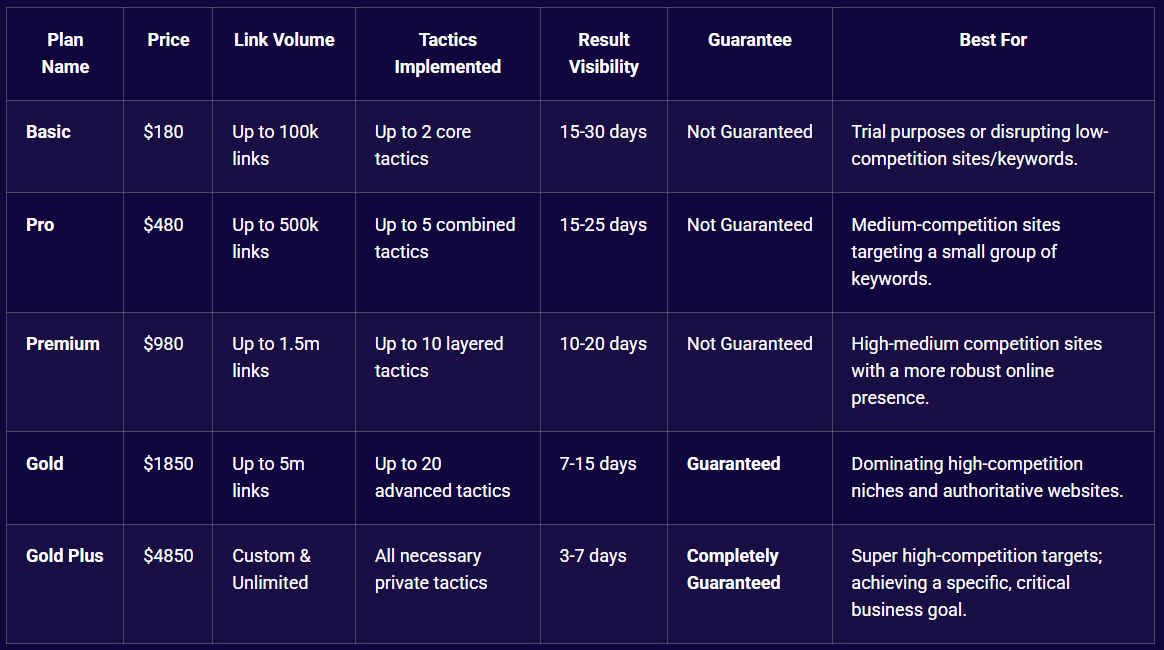 Our Basic plan serves as an excellent entry point to test the waters. Subsequently, the Pro and Premium plans scale up the intensity, combining multiple tactics for a more significant impact. For the most serious campaigns, our Gold and Gold Plus plans offer guaranteed results, employing a full-spectrum assault using custom and private methods until the desired outcome is achieved.
The Ethics and Legality of Negative SEO: A Realistic Perspective
It is crucial to have a clear understanding of the ethical and legal landscape of negative SEO. Most tactics discussed here, such as building spammy links or creating duplicate content, operate in a legal gray area. They are direct violations of a search engine’s terms of service—like those outlined in Google’s Spam Policies—but they are not inherently illegal activities.
The goal of these methods is to manipulate a search algorithm, not to commit a crime. However, some tactics cross a definitive legal line. For example, hacking a competitor’s website (gaining unauthorized access) or using their trademarked name in a defamatory way could lead to legal consequences. This is why professional services focus on off-site strategies that influence search engine algorithms without breaking the law.
A reputable provider will be transparent about their methods and will focus on algorithmic manipulation rather than illegal activities. The objective is to win the ranking war, and doing so within the bounds of what is strategically possible without creating undue legal risk is the hallmark of a true professional.
Frequently Asked Questions (FAQs) About Negative SEO Services
Here are answers to some of the most common questions we receive when clients want to buy negative seo service.
Is a negative SEO campaign guaranteed to work?
While many tactics have a very high success rate, only premium plans from established providers typically come with a guarantee. The effectiveness depends on the target’s authority and the plan chosen. However, even basic plans can cause significant disruption for less established competitors.
How long until I see results from a negative seo attack?
Results can appear in as little as 3-7 days with the most aggressive campaigns, or within 15-30 days for basic plans. The timeline depends on the target’s existing authority, the tactics used, and how quickly search engines react to the new signals.
Can a competitor know they are under a negative SEO attack?
A professionally executed campaign looks like the target is engaging in manipulative SEO practices themselves. The methods are designed to be discreet and avoid direct attribution, making it extremely difficult for them to prove an attack occurred or identify the source.
What is the difference between black hat negative seo and regular SEO?
Regular SEO focuses on improving your own website’s rankings. Black hat negative seo, on the other hand, is the specific practice of using tactics that violate search engine guidelines to actively harm a competitor’s rankings, which is the focus of these services.
Do you offer a negative seo checker service?
While not a formal standalone service, any professional provider conducts a deep analysis of your competitors as part of a campaign plan. This analysis effectively serves as a check for vulnerabilities that can then be exploited to formulate the most effective attack strategy.
Is it easy to recover from a negative SEO attack?
No, recovery is difficult, time-consuming, and expensive for the target. They must identify the attack vectors, disavow links, file takedown notices, and repair their reputation, all of which takes significant effort and resources, giving you a long-term competitive advantage.
Why not just buy a cheap service on Fiverr?
While you can find “negative seo” gigs on platforms like Fiverr, they are typically low-quality, ineffective, and use public, easily-traced tools. A professional service provides strategic, powerful, and discreet campaigns that are far more effective and safer to use.
Conclusion: Taking Decisive Action
In the ruthless arena of online business, passively standing by while competitors dominate the top search results is not a viable strategy for growth. Strategic negative SEO is a powerful and effective tool for disrupting the status quo and carving out your own space at the top. By understanding these advanced tactics, it becomes clear how a professional campaign can systematically dismantle a competitor’s fragile rankings.
Choosing the right approach and the right provider is paramount to success. For a discreet, expert-led campaign designed to deliver tangible results, a professional service is the only logical choice. If you are ready to stop being outranked and want to secure your position in the market, it is time to buy negative seo service. For any questions, feel free to contact our team to discuss a custom strategy.



Reviews
There are no reviews yet.